You're viewing an older version of the aµtoPULSE help. For the latest version, visit online help 1.3.
Refer to the following list of commonly used terms to familiarize yourself with the instrument and its functions.
A protocol consists of a configuration of stations, defined labware, and profiles to be run using user-defined parameters.
A profile defines the filtration parameters for each individual sample in a protocol, including chip selection, labware selection, concentrating/exchanging volumes, and advanced setup (e.g., the chip’s cleaning/mixing cycles and pressure settings).
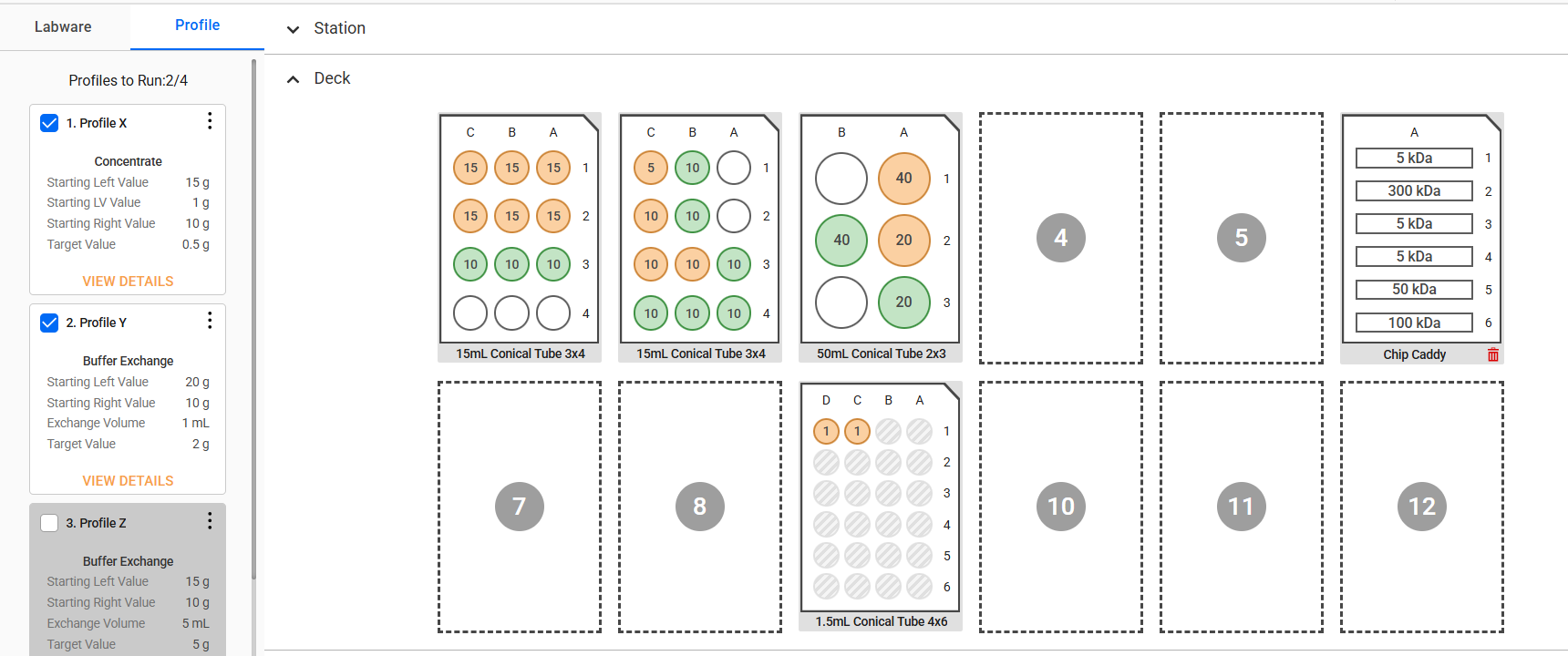
Labware is the equipment used to hold liquids during protocol runs. It is arranged on the deck and defined visually in the Editor page. The compatible labware types for the aµtoPULSE deck are:
The filtering devices used in aµtoPULSE are called chips. Chips are automatically placed in the Stations by the gantry during protocol runs. Chips cover a wide range of Molecular Weight Cut-Off (MWCO) selections to accommodate different experiments. For more information, see the chip specifications in the Instrument Overview topic.
The virtual deck and station cards panel in the Editor page represents the corresponding parts of the instrument and is where the labware is arranged and profiles are configured.
Virtual Deck
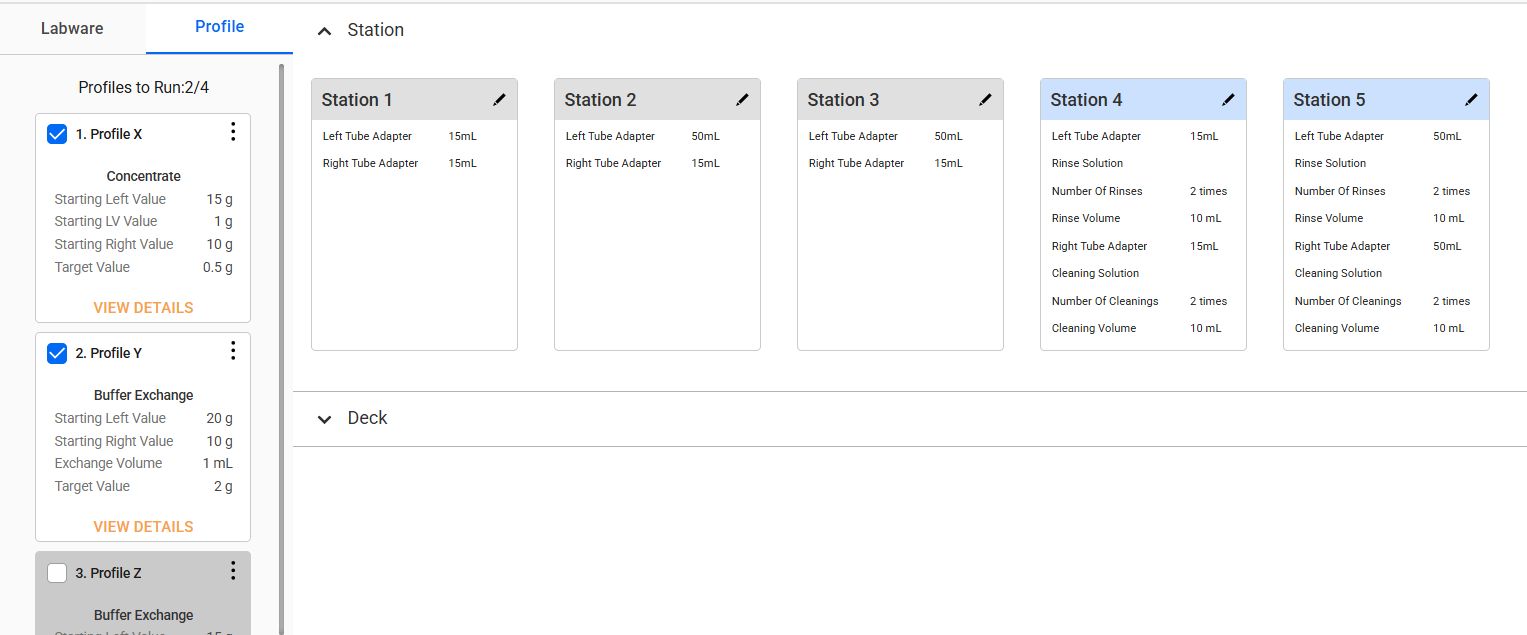
Station Cards Panel
The station cards panel also appears in the Runtime Status page to display the current status during a protocol run. Clicking on the More info icon  on a station will switch the live graph view to that profile.

Station Cards in Runtime Status Page
A station is where aµtoPULSE performs its filtration and cleaning operations. Each station is equipped with a chip clamp, permeate and buffer tubing, tube adapters, and scales for volume tracking. For more information, see Instrument Overview.
Note: The tubes in a station are placed in the T1, T2, and T3 slots. T1 and T3 refer to the left and right tube adapters respectively, while T2 refers to the center microtube adapter.
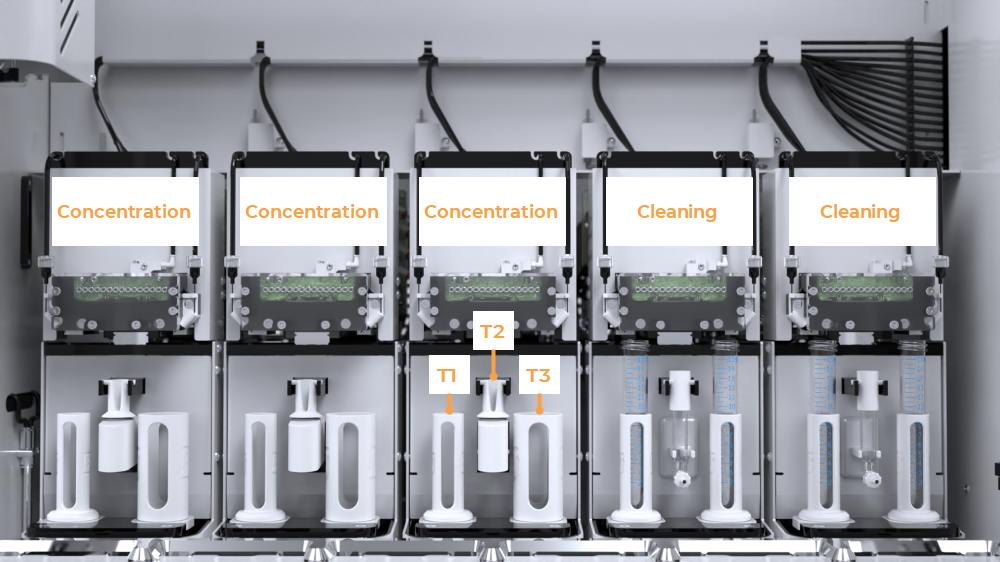
The aµtoPULSE Stations in a 3-2 Configuration
aµtoPULSE provides two filtration methods: Concentrate and Buffer Exchange. Both methods concentrate your sample using a filter membrane, removing buffer and small impurities. Buffer Exchange additionally replaces the original buffer with a new one using stepwise addition.
The following processes are possible steps in a profile:
Transferring: Moves sample/buffer between conical tubes through the chip.
Concentrating: Reduces sample volume by pushing liquid through the chip’s diaphragms and membrane. Small molecules pass as permeate, and larger molecules are retained, creating a more concentrated sample.
Prime: The priming cycle fills the chip membrane with either buffer or sample solution before concentrating to remove air bubbles from the chip before filtration.
Recovery: The recovery cycle returns your sample from the chip back into the tube using buffer solution and/or air after running a protocol.
Mixing: The mixing cycle recirculates the sample through the chip and conical tubes to ensure even sample distribution and avoid clogging. High-viscosity solutions may have decreased mixing performance.
Chip Cleaning: The chip cleaning cycle automatically flushes all flow paths with a cleaning solution to remove residual material and condition the chip. It then rinses with a neutralizing buffer, preparing the chip for sample processing.

|
|
| APOWH-V12R125 |