Purchase Orders Overview
A Purchase Order (PO) is a formal document issued by the Purchasing team to a supplier. It records what is being ordered, the quantity, the price, and the payment terms.
POs in TIGA are created from the Purchase Orders table and are most commonly used to fulfill purchasing needs from an Open to Buy or Issued Work Orders (WO). TIGA tracks whether available stock is sufficient to meet each WO’s needs and shows any shortfall in the Discrepancy column of the Work Order Line Items (WOLI). When the Discrepancy value is greater than zero, the Purchasing team creates a PO to purchase the required items and links it to the related WO.

Discrepancies in Work Order Line Items
However, not all POs are linked to a WO. In some cases, Purchasing still needs to create a PO without a WO reference, such as when receiving replacement items, purchasing urgently needed items from another supplier with a faster lead time, or forwarding stock between locations.
Purchase Order Types
Every Purchase Order must be assigned a Purchase Order Type: Inventory or Non Inventory. The selected type defines the purchasing workflow, including shipment creation, receiving activities, customs-related documents, and vendor bill generation.
Inventory PO |
Non Inventory PO |
|
|---|---|---|
Definition |
The purchase requires shipment and warehouse receiving processes. Goods are received into the warehouse and recorded in inventory. |
The purchase does not require shipment or warehouse receiving processes. No inventory movement is involved. |
Item Categories |
Goods only. |
Goods and/or Service. |
Shipment Record |
TIGA prompts the user to create it when the PO status is set to Sent and enables the Create Shipment action. |
TIGA skips the prompt and disables the Create Shipment action. |
Warehouse Receiving |
Required. The Warehouse team receives the Goods and confirms the transaction in TIGA. |
Not required. TIGA blocks any attempt by the Warehouse team to receive against this PO. |
Customs Documents |
For PRO and PSL (Indonesian bonded zone entities), the Exim team prepares the customs documents (BC documents) for incoming goods. |
Not required. TIGA prevents the Exim team from creating customs documents for this PO. |
Vendor Bill Record |
Auto-created by the system after the PO is Closed based on confirmed Transaction Line Items. |
Auto-created by the system when the Accounting team force-closes the PO based on Purchase Order Line Items. |
Important
The Purchase Order Type field is mandatory when creating a PO. Once Purchase Order Line Items (POLI) have been added, the type can no longer be changed. The type can be updated only when the status is Draft, Multi, or Revised, and no POLI is linked yet.
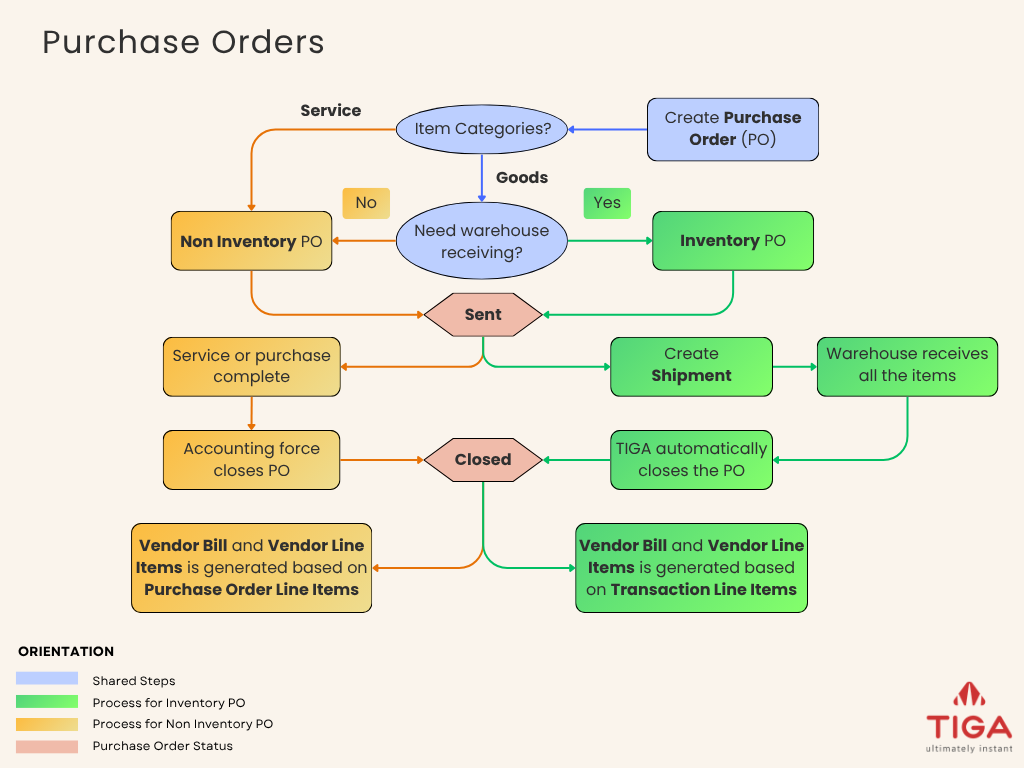
Purchase Order Flow
Inventory Purchase Orders
An Inventory Purchase Order (PO) is used for purchases that require shipment and warehouse receiving processes. Purchased items are delivered to the warehouse, received by the Warehouse team, and processed through inventory transactions in TIGA. All items on an Inventory PO must be of type Goods.
The following purchases are categorized as an Inventory PO:
Regular purchase of Goods line items to fulfill the Open to Buy or Issued WO.
“PO Shipment” to forward purchased items from FUSA warehouses to the import warehouses in Indonesia. In this process, Bedford Supply (FUSA) acts as the supplier.
“PO Subcontract” to cover external processing of goods where physical items, such as materials, tools, or semi-finished goods, are sent to the vendor for processing and returned to the company after the subcontract process is completed. It is done by marking the Sub Contract checkbox.
POs to order items when inventory is available, but the existing stock does not meet the required quality standard.
POs to order urgently needed items. For such items already ordered on another PO, a new PO can be created for a supplier that can offer a faster lead time.
POs to receive replacement items of rejected items from suppliers or to process the returned instruments from customers or the Support team.
POs to replace an import PO when an international vendor sends purchased items to Indonesia, but requires a switch to local shipment due to shipping policy or mistake. This PO is used to ship the item between cities in Indonesia.
Non Inventory Purchase Orders
A Non Inventory Purchase Order (PO) is used for purchases that do not require warehouse receiving processes or inventory movement. These purchases are completed without creating shipments, receiving transactions, or customs-related documents. A Non Inventory PO can contain Service items, Goods items, or a combination of both.
Examples of orders that use a Non Inventory PO:
Services performed by third parties, such as installation, translation, laboratory testing, or equipment rental services.
Goods that do not require warehouse receiving or inventory tracking based on company practices.
Software licenses, subscriptions, or other non-physical products.
Important
If the user attempts to create a Shipment In transaction linked to a Non Inventory PO, the system displays an error. Similarly, the Exim team cannot create or link a Shipment record to this PO.
Non Inventory POs cannot be created with FUSA as the supplier and cannot have the Sub Contract checkbox enabled.
Item Categories: Goods and Service
The Item Categories table includes a Purchase Type field used to classify items as Goods or Service. This classification determines which PO type the item can be added to and whether the item can be used in warehouse processes.
Goods — Items with physical or tangible forms used in inventory movement and warehouse activities. Goods items can be added to both Inventory and Non Inventory POs.
Service — Intangible products or activities that do not involve inventory movement or warehouse receiving activities. Service items can only be added to Non Inventory POs.
Note
Service items cannot be added to the Transaction Line Items, Item Request Line Items, or Part Replacements tables.
Service items cannot be processed in Warehouse Adjustment and Warehouse Transfer actions from the Item Inventories table, and Move Part to Different Bin action from the Bin Inventories table.
Important
Only members of the “Accounting” group can update the Purchase Type in the Item Categories table. The update is only allowed after all linked Purchase Orders have been Closed and all linked Transaction Line Items have been Confirmed.
Purchase Order Status
Each Purchase Order (PO) is assigned a status that indicates its progress from creation to completion. The following statuses are used in the PO process:
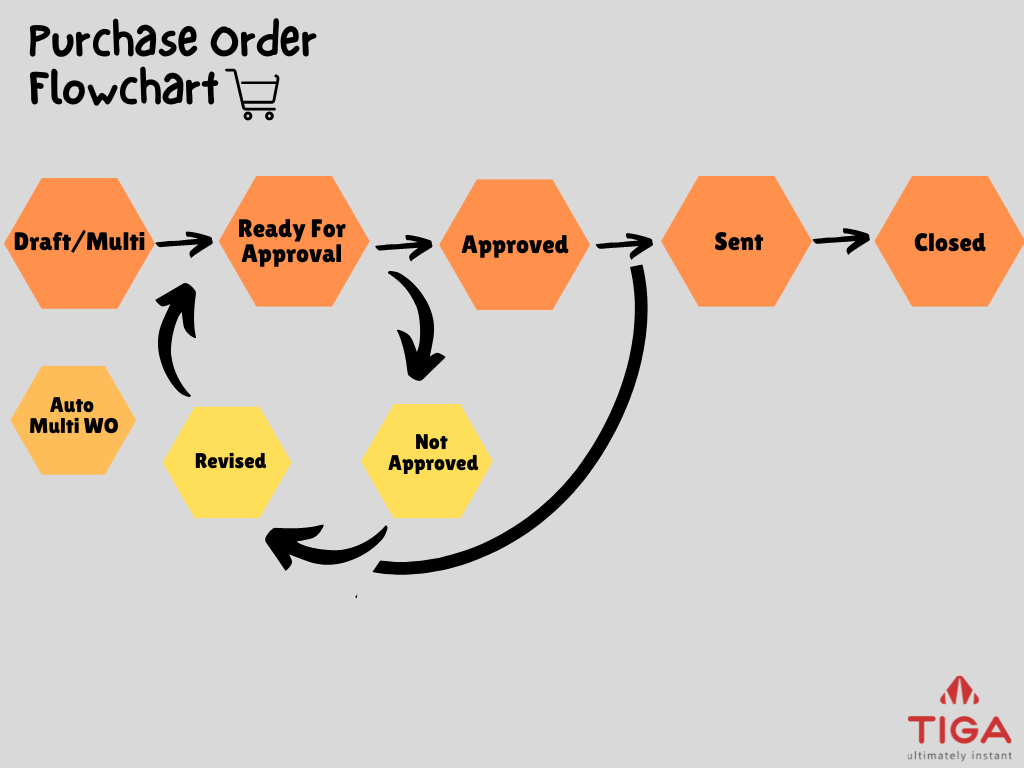
Purchase Order Flowchart
Draft
Draft is a status used when the Purchasing team is still preparing the PO. The PO can still be edited, linked to one or multiple Work Orders, and adjusted before entering the approval process.
The Purchasing team typically uses Draft when the PO still requires manual review, price confirmation, supplier discussion, or additional updates before it is finalized.
Multi
Multi is a status used for a PO intended to consolidate purchasing needs from multiple Work Orders for the same supplier into a single PO.
The Purchasing team typically uses Multi when they want the PO to remain available for manual linking to WO or through automatic grouping processes such as Auto Multi WO, where TIGA automatically adds eligible Work Order Line Items to the PO.
If the PO details are complete, the Purchasing team updates the status to Ready for Approval.
Important
Previously, only one Multi PO was allowed per Company. TIGA now allows two POs with Multi status per Company, provided the Purchase Order Type is different, one Inventory and one Non Inventory.
Ready for Approval
Ready for Approval indicates that all PO requirements have been completed and is ready for review. TIGA automatically sends a notification email to the Approver named on the PO.
Most POs are reviewed by an Approver from the Purchasing team and can not be approved by its Assignee. However, certain POs require a specific approver:
Finance Controller approval is required for POs over IDR 50,000,000 and for POs that go through a bidding process.
Purchasing Manager approval is required when:
Payment terms are Transfer in Advance or Cash On Delivery.
The total amount is USD 500 or more, or IDR 5,000,000 or more.
The PO is for a tax-exempt supplier.
The supplier’s bank account is a personal (non-corporate) account.
All other POs that do not meet the criteria above are approved by the Sourcing Buyer.
Approved
Approved indicates that the PO has been reviewed and approved. The Assignee receives an automatic email notification of the approval. The next step is to update the status to Sent to issue the PO to the supplier.
Not Approved
Not Approved indicates that the PO was rejected during approval review. TIGA notifies the Assignee automatically upon rejection, and the Approver informs the Assignee regarding the rejection reason. The Assignee must review the feedback and change the PO status to Revised first before making the necessary corrections.
Note
POs with the following statuses can still be edited:
Draft
Multi
Ready for Approval
Not Approved
Approved
An Approved PO may need adjustment if:
The supplier changes delivery schedules, lead times, prices, or item availability.
The requester cancels or changes the purchasing request.
Revised
Revised indicates that the PO is currently being modified after it was previously rejected or after changes were requested. After the revision is complete, the status must be updated to Ready for Approval so that the approval process can restart.
Sent
Sent indicates that the PO has been finalized and officially issued for purchasing, payment, and delivery processes. At this stage, all PO details, line items, pricing, and terms have been reviewed and confirmed.
Using the Download PO action, the Purchasing team can generate the official PO document to share with suppliers and related internal teams for reference. TIGA automatically sends a notification email to the Purchasing team and the po@formulatrix.com mailing list after the PO status changes to Sent.
Note
After the status changes to Sent:
For Inventory PO, TIGA prompts the user to create a Shipment record to support incoming delivery tracking and warehouse receiving processes when the purchased Goods arrive.
For Non Inventory PO, TIGA does not display the prompt because shipment and warehouse receiving processes are not required.
If all ordered items or services have been completed, the PO can be Closed.
Closed
Closed indicates that all purchasing activities for the PO have been completed and the PO no longer requires further processing. The Assignee, Approver, and Warehouse team receive email notifications when the purchasing process is complete, and the PO status changes manually or automatically to Closed.
Note
For Inventory PO, TIGA automatically changes the status to Closed after all ordered items have been received and the linked Transaction Line Items have been confirmed. TIGA then automatically creates Vendor Bills and Vendor Bill Line Item records based on the Transaction Line Items.
For Non Inventory PO, the PO is force-closed by the Accounting team once the service or purchase has been completed. TIGA then automatically creates Vendor Bills and Vendor Bill Line Item records based on the Purchase Order Line Items.
Auto Multi WO
Auto Multi WO is a special status that triggers automatic grouping of Work Orders (WOs) into an existing Multi PO.
When this status is selected, TIGA searches eligible WOs with Open to Buy or Issued status, identifies line items with Discrepancy, and automatically adds the items from the same preferred supplier to the current PO.
The Purchasing team typically uses this process to combine purchasing requests from multiple WOs into a single PO and reduce the number of separate purchasing and shipment processes. For more information, see Auto Multi WO.
Note
Auto Multi WO can only be used when the current PO status is Multi.
The Purchase Order Line Items added by the process depend on the Purchase Order Type.
Inventory POs only collect Goods items from eligible WOs.
Non Inventory POs can collect both Goods and Service items, but Subcontract WOs are excluded.
Purchase Order Priority
The Purchase Orders table provides two Priority options to indicate the required handling priority by the FUSA warehouse team.
Standard — The PO can be processed through the normal warehouse and shipment handling process.
Engineering — The PO requires prioritized handling by the FUSA warehouse or logistics teams. This option is typically used for urgent operational needs, such as parts required immediately by Engineers or shipments that require special handling conditions, such as cold shipments.