Reagent Exchanger (RX)
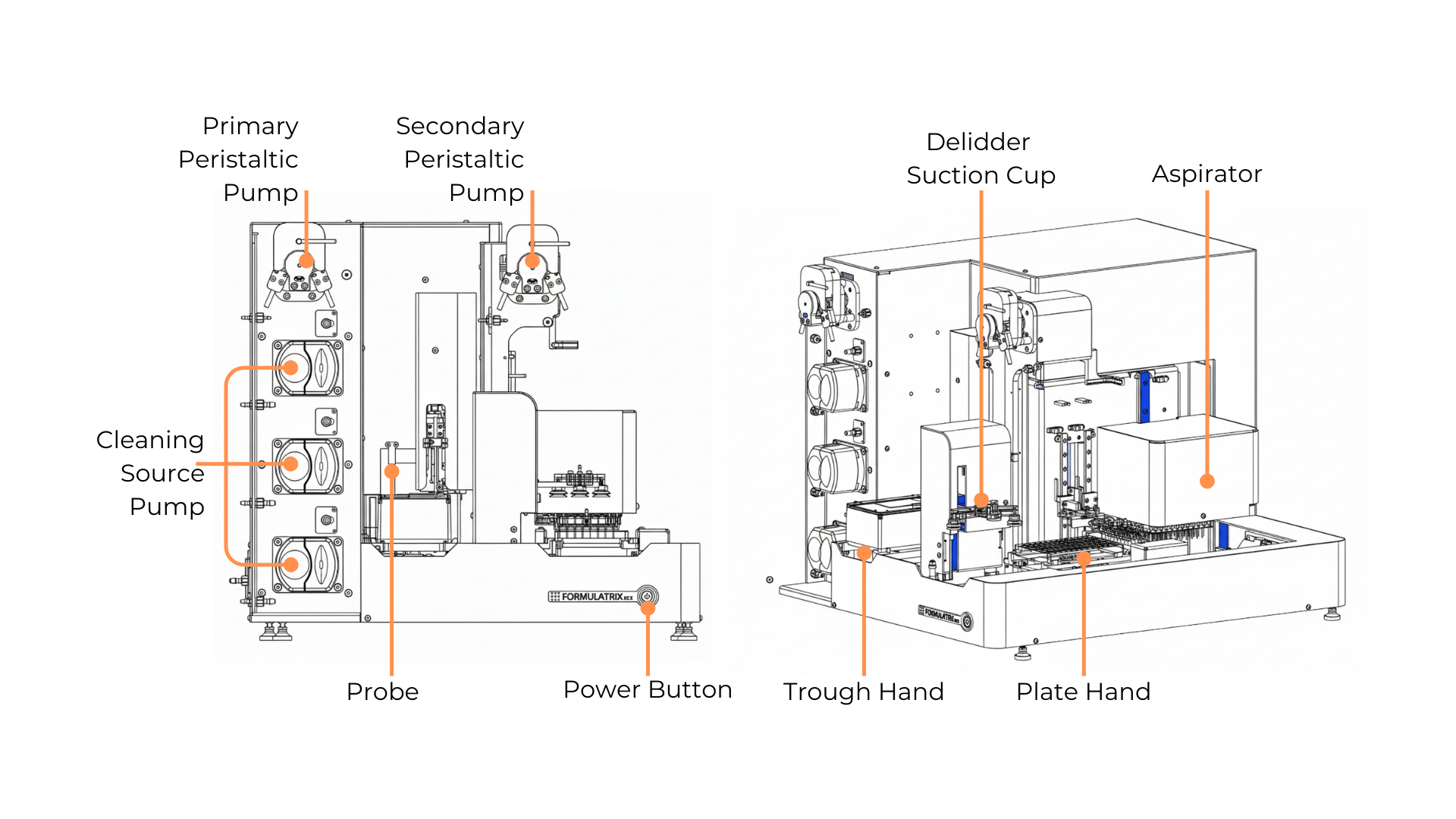
Reagent Exchanger (RX)
The Reagent Exchanger aspirates spent media to waste and dispenses fresh media to cells for high throughput media exchanges of cell culture plates.
The RX aspirator features 96 straight stainless steel nozzles arranged in twelve individually controlled rows of eight. The first row is a single-column aspirator that can move independently in the vertical direction to aspirate liquid from a tilted one-well, four-well, and eight-well plate, while the back eleven rows are fixed in place. For 96- and 384-well plate aspiration, the first single-column aligns itself with the back fixed rows and the whole head comes down for a one-shot aspiration. After every use, the aspirator is cleaned in the Main Cleaning Station to prevent contamination.
The RX dispensers (primary and secondary) feature eight angled stainless steel nozzles with adjustable flow rates for quick, gentle, side-wall, non-contact dispensing. The primary dispenser uses a peristaltic pump to dispense liquid from the trough onto the plate, while the secondary dispenser dispenses PBS or other washing solutions from external containers.
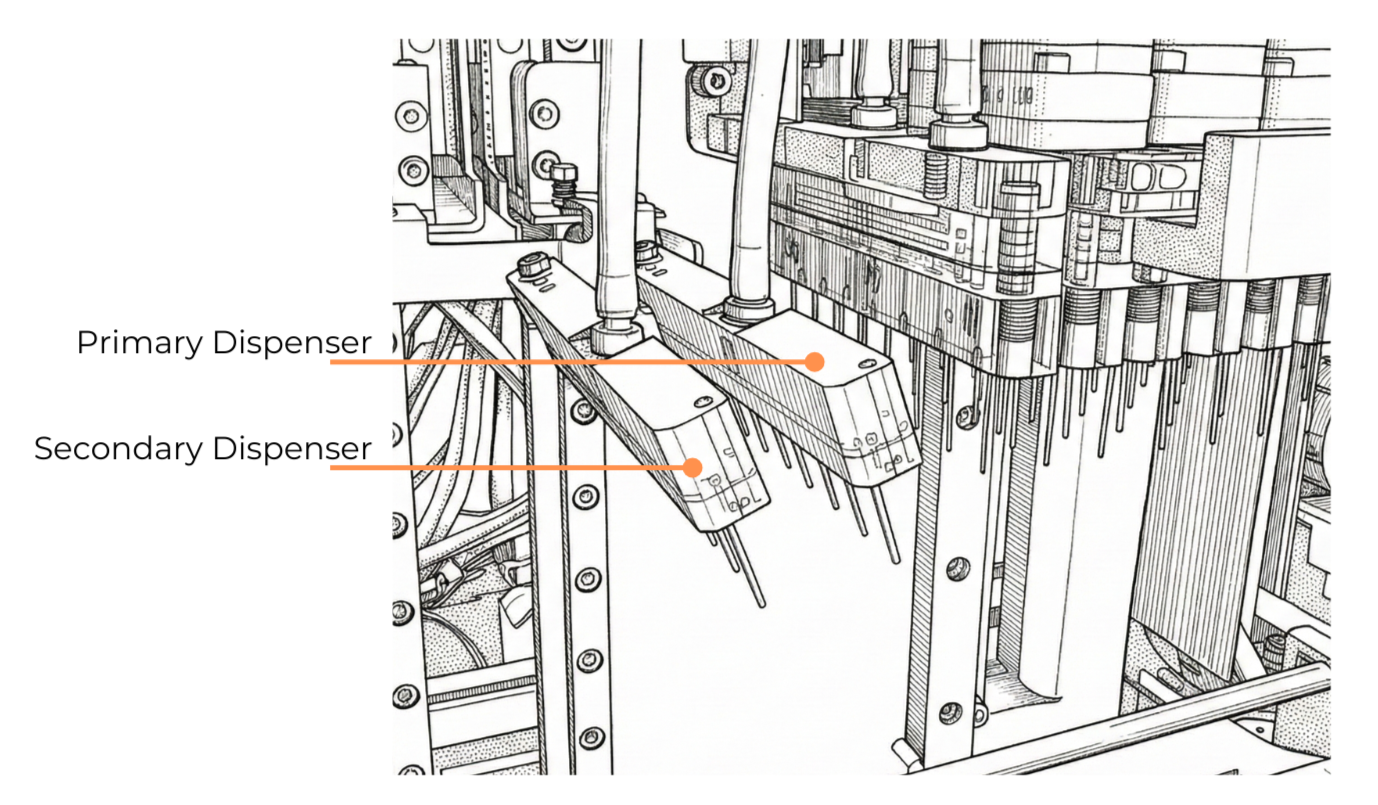
The RX Dispenser
A magnetic stir bar in each automation reagent reservoir keeps cells in even suspension, making possible the plating of an equal number of cells to each well of a 96-well plate.
The probe and main cleaning stations use hydrogen peroxide (H2O2) or other disinfecting reagents and distilled water to clean the trough hand probe, primary dispenser, secondary dispenser, and aspirator nozzles after every use to prevent contamination and clogging. Four liquid lines in, and one out to waste, connect to the two cleaning stations. Generally, these liquid sources are Cleaning Solution 1 (H2O2 or alcohol), Cleaning Solution 2 (distilled water), Cleaning Solution 3 (distilled water), and Secondary Dispenser Line.
In the RX, cell culture plates can lie flat or tilt depending on the cell type, user’s needs, and applications. Tilting is more effective for 100% and partial media exchanges in one-well, four-well, and eight-well plates. Flat is more effective for partial media exchange in 96-well and 384-well plates.
In addition to media exchange and cell plating, RX dispenses dissociation reagent to cells prior to passaging. RX can rock plates with cells back and forth to fully coat the plate bottom with even a small volume of reagent. Dispense-rock-aspirate-dispense is an effective way of washing cells before incubating them with a dissociation reagent. Washing cells is especially important when maintenance media contains serum.
The RX delidder removes and replaces plate lids to minimize task time and optimize throughput. Once the protocol is complete, the Rover takes the plate and transports it to the next scheduled task.
RX and FLO i8, the other liquid handler in the system, are Cellmatic’s bench scientists. They do the central cell culture tasks that result in healthy cells in the number and plate format for the assays you need.
Bottle cap for Reagent Exchanger
The bottles—outside liquid sources—that connect to the Reagent Exchanger (RX) use a custom bottle cap, provided by FORMULATRIX. The cap has two ports connected to tubes. One short tube, capped by a hydrophobic filter, extends upward to allow airflow and to filter contaminants. The other tube extends downward into the bottle. To maintain sterility, the port connected to the downward-facing tube must be covered with a silicone plug. This plug should only be removed when connecting the port to the RX tube.
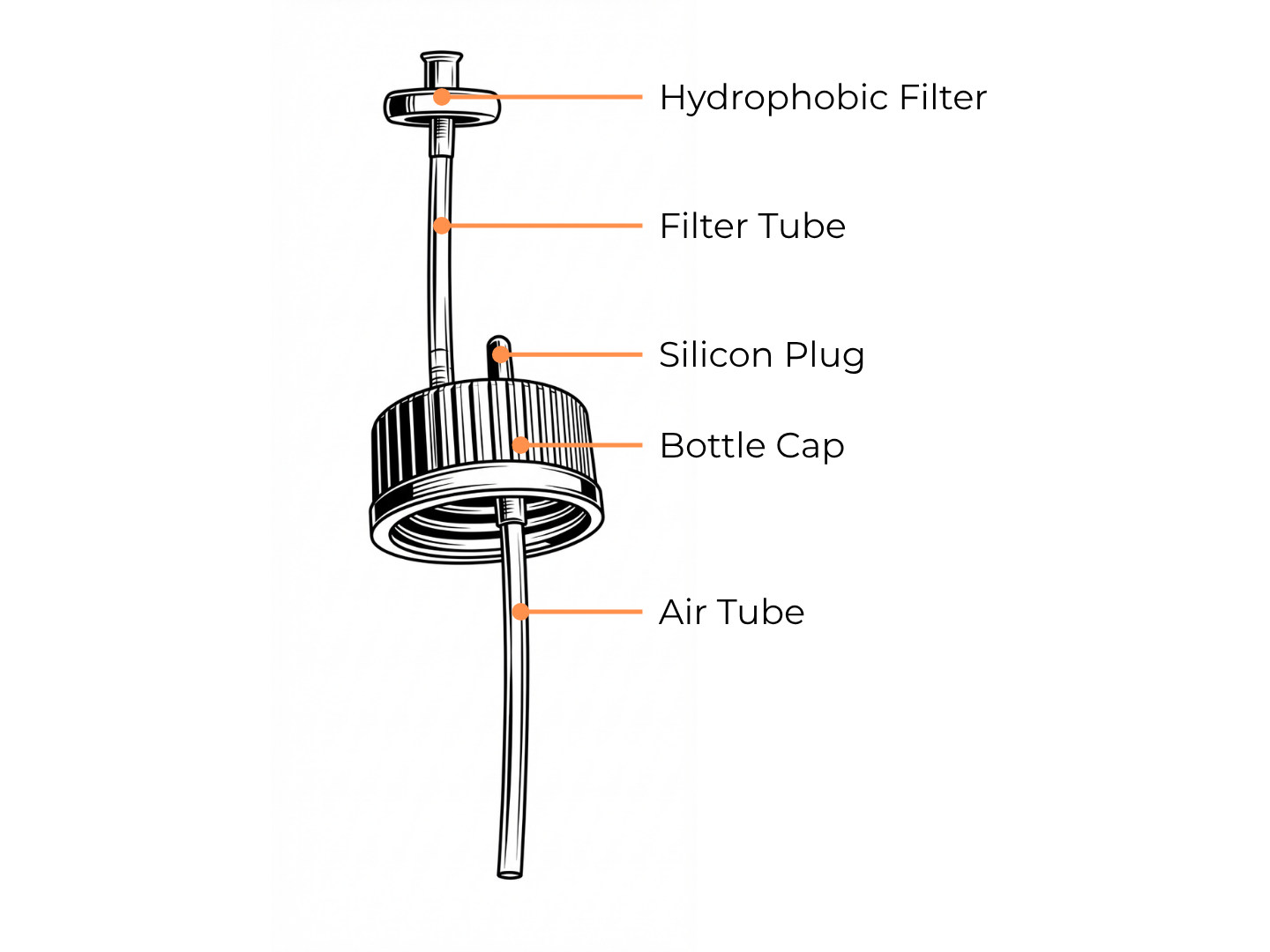
The Customized Bottle Cap in RX
Cleaning Solution Containers
RX Liquid Supply, located on the left side of Instrument Cabinet 1, houses four 10 L cleaning solution containers containing washing solution (PBS), H2O2 or alcohol (Cleaning Liquid 1) and sterile distilled water (Cleaning Liquid 2 and 3).
These cleaning solutions are essential for maintaining the system’s hygiene. Each container features a custom cap and an integrated water level sensor that turns red when the liquid supply runs low. Monitor the clean solution status from Cell Suite by going to Dashboard > Instruments > Wash Containers.
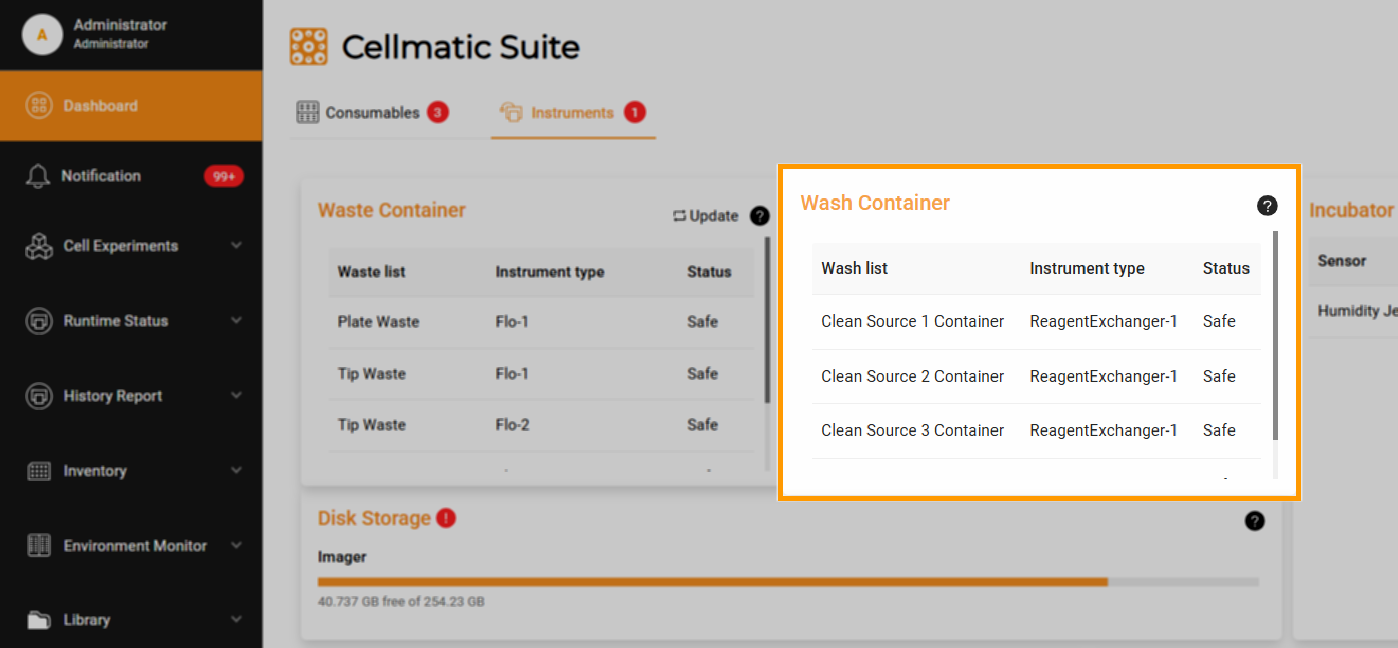
Monitoring RX Containers
Automation Reagent Reservoir
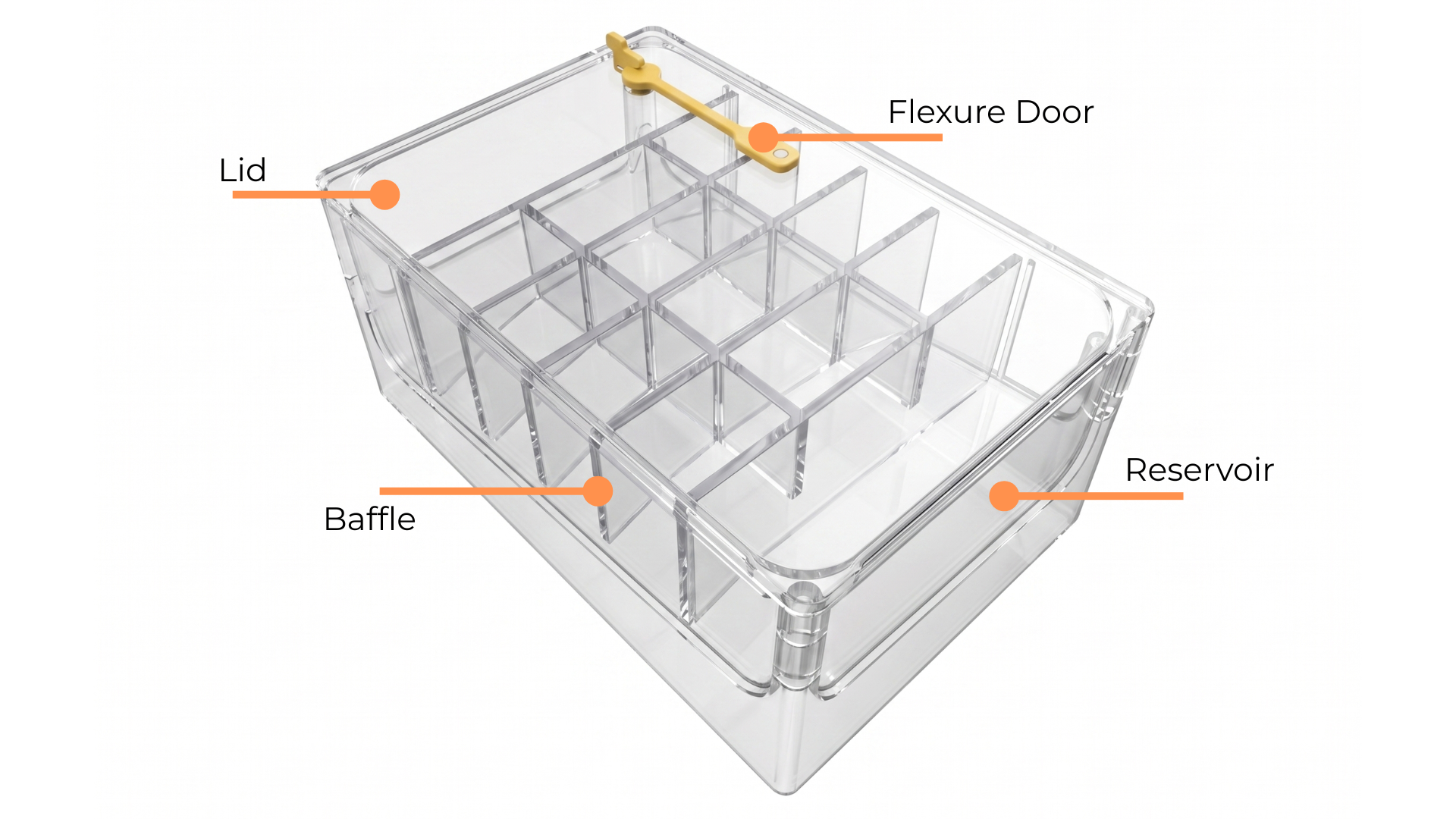
Automation Reagent Reservoir
The High-volume automation reagent reservoir is designed to carry cell culture media, reagents, and cell suspensions for dispensing into microplates. It holds up to 250 mL, with a safe working volume of 200 mL and a minimal dead volume of <5 mL.
To maintain solution stability and prevent degradation, filled reservoir are stored in the Refrigerator Storage at 4-8 °C. When needed, Rovers transfer them to the Media Warmer. Within this volume range, Cellmatic dispenses efficiently to reduce waste and conserve valuable media and reagents.
The automation reagent reservoir includes the following components:
Components |
Description |
|---|---|
Automation Reagent Reservoir |
A single-use main container that holds reagent or solution. |
Lid with Flexure Door |
A cover with small reclosable sliding flap above a lid opening for reagent aspiration. |
Baffle |
An internal divider in trough to reduce liquid sloshing and stabilizes the solution. |
Related Topics: